Body and structural members
Longitudinal rails, cross-members, roof supports, subframes, side structures, brackets, and lightweight frame assemblies.
Application pathway
Lightweight structural, crash-management, battery, trim, and thermal profile concepts for vehicle manufacturing.
Application guide
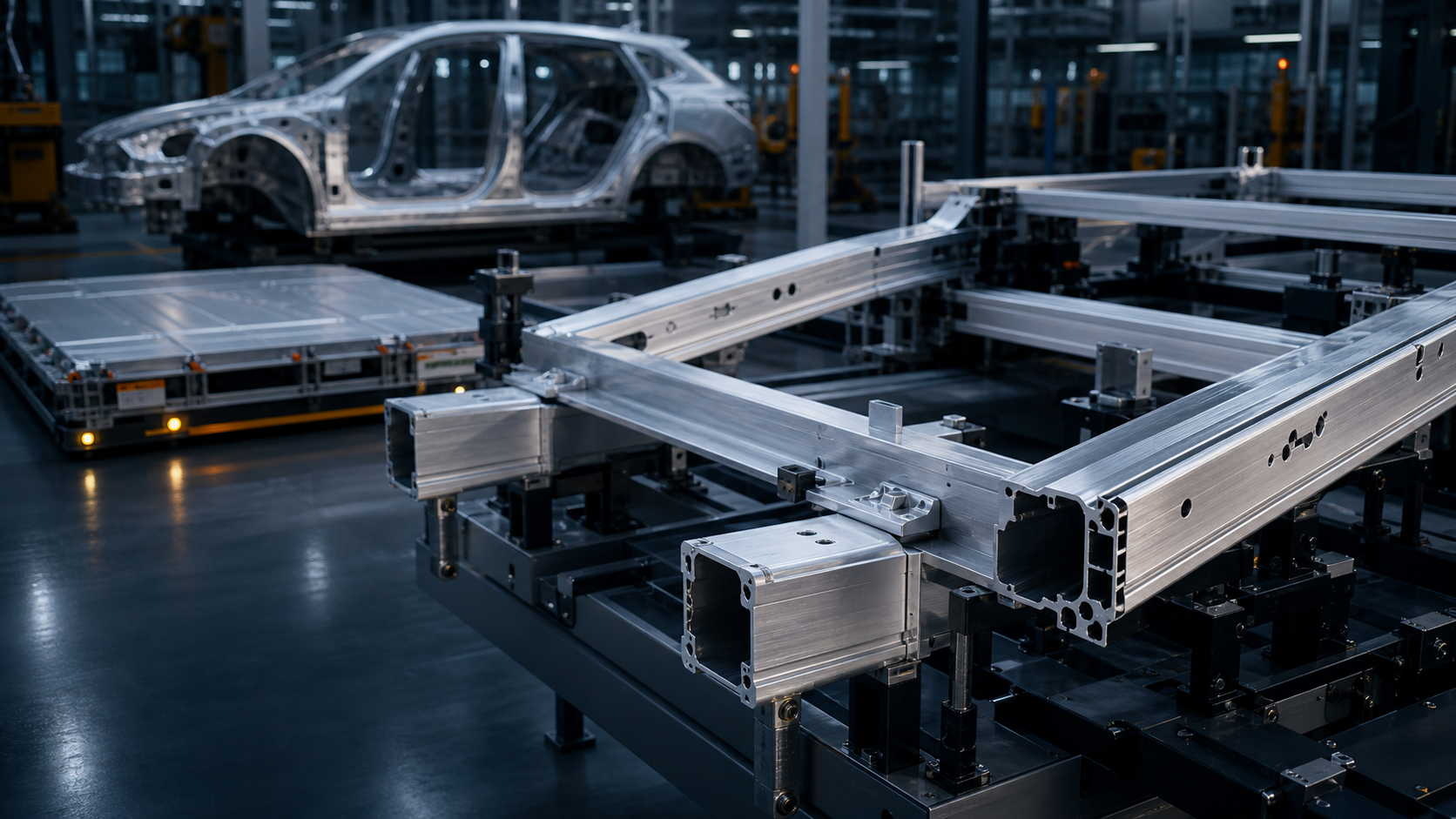
Automotive extrusions can form lightweight structural members, crash-management components, battery and electronics housings, roof and body rails, steps, trim carriers, and thermal-management parts. The section is developed as one element of a complete vehicle system, with geometry coordinated around loads, joining, corrosion protection, manufacturing rate, assembly sequence, and repair strategy.
Longitudinal rails, cross-members, roof supports, subframes, side structures, brackets, and lightweight frame assemblies.
Bumper beams, crush cans, reinforcement sections, and controlled-deformation members designed by the vehicle engineering team.
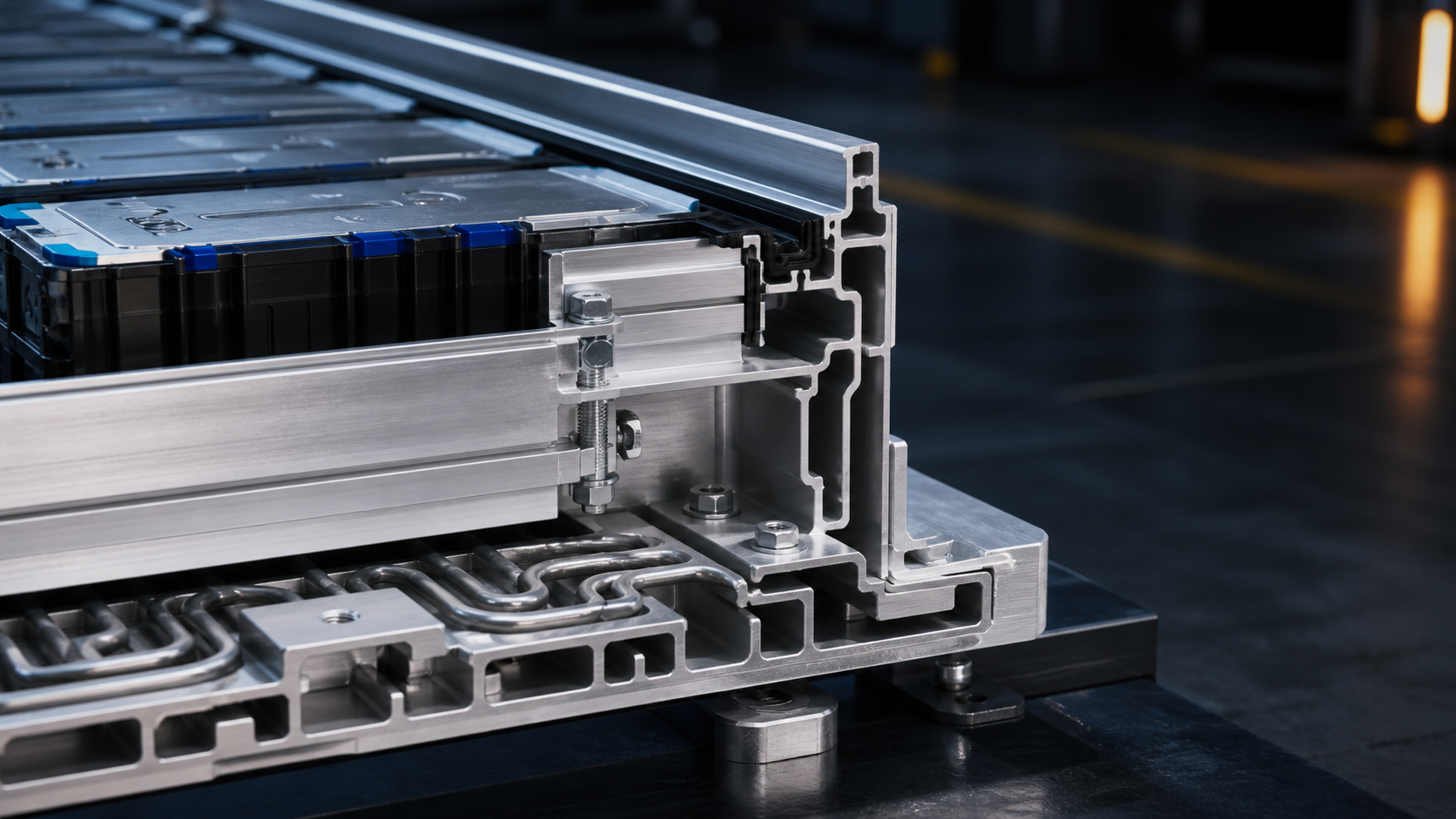
Battery-tray rails, enclosure frames, sealing lands, cooling interfaces, cable routes, inverter housings, and protective members.
Running boards, roof rails, door or window members, seat tracks, heat sinks, motor housings, and visible trim sections.
Vehicle system detail
This image position is reserved for a separate battery-frame, crash-member, body-rail, running-board, or thermal-system view.
Assembly mechanics
These principles explain the role of the extrusion inside the finished assembly. Final dimensions and performance must be checked against the project design and selected hardware.
Principle 01
Outer walls, internal webs, hollows, and attachment flanges create bending, torsional, bearing, and local stiffness along the vehicle structure.
Principle 02
Welds, bolts, rivets, adhesives, inserts, cast nodes, and formed end features connect the extrusion to sheet, cast, or composite components.
Principle 03
Vehicle engineers tune geometry, alloy, temper, trigger features, joints, and deformation space so selected components collapse in a controlled manner.
Principle 04
Sawing, machining, bending, forming, joining, coating, inspection, and sequenced delivery convert long profiles into repeatable vehicle parts.
Alloy guidance
The final alloy and temper are confirmed against the controlled drawing, required strength, extrusion geometry, fabrication route, finish, and service environment.
Alloy status
Availability, temper, tolerances, and suitability are confirmed during technical review.
Engineering fit
Common requirements
Profile response
Technical decision points
Define load paths, stiffness, energy-management intent, deformation envelope, fatigue duty, and vehicle-level validation responsibilities.
The section must fit body, battery, suspension, glazing, trim, service, and occupant-clearance zones while preserving tool access.
Material stack, weldability, adhesive gaps, rivet or bolt access, inserts, heat input, distortion, and corrosion isolation require early coordination.
Cycle time, datum scheme, automated handling, machining fixtures, poke-yoke features, inspection frequency, and line-side presentation affect geometry.
Road salts, trapped moisture, dissimilar metals, drainage, sealants, coatings, visible surfaces, and stone-impact exposure should be reviewed.
Fastener access, replacement boundaries, joining method, crash repair approach, drainage, and protection influence the final component design.
Practical technical facts
One profile can carry load while also providing mounting flanges, sealing lands, cable channels, locating features, and finished edges.
Crash, fatigue, stiffness, sealing, and durability depend on the complete joined assembly rather than the isolated profile.
Battery, power-electronics, inverter, and motor systems create opportunities for structural housings and heat-transfer profiles.
Clear locating faces and tolerance strategy improve machining, gauging, automated assembly, and repeat supply.
Drawing-led RFQ
Send the cross-section and application context for manufacturability review. Customer-specific geometry remains confidential and is not published as a case study.
Automotive requirement context
Automotive aluminium profiles can serve structural, enclosure, trim, thermal, and assembly functions when the component drawing and validation requirements are clearly defined.
Automotive aluminium sections for vehicles, buses, trucks, or commercial-vehicle assemblies require review of interfaces, joining, loads, finish, tolerances, fabrication, inspection, and recurring volume.
Omalco confirms profile feasibility and supply scope against the drawing. This page does not claim vehicle-level validation, completed programs, or universal component suitability.