01
Section feasibility
Review the cross-section, functional interfaces and critical geometry before the tooling route is defined.
Custom extrusion engineering
Turn a custom aluminium profile drawing into a defined tooling, trial and approval route. Omalco begins with the application, geometry and supply requirement before die development moves forward.
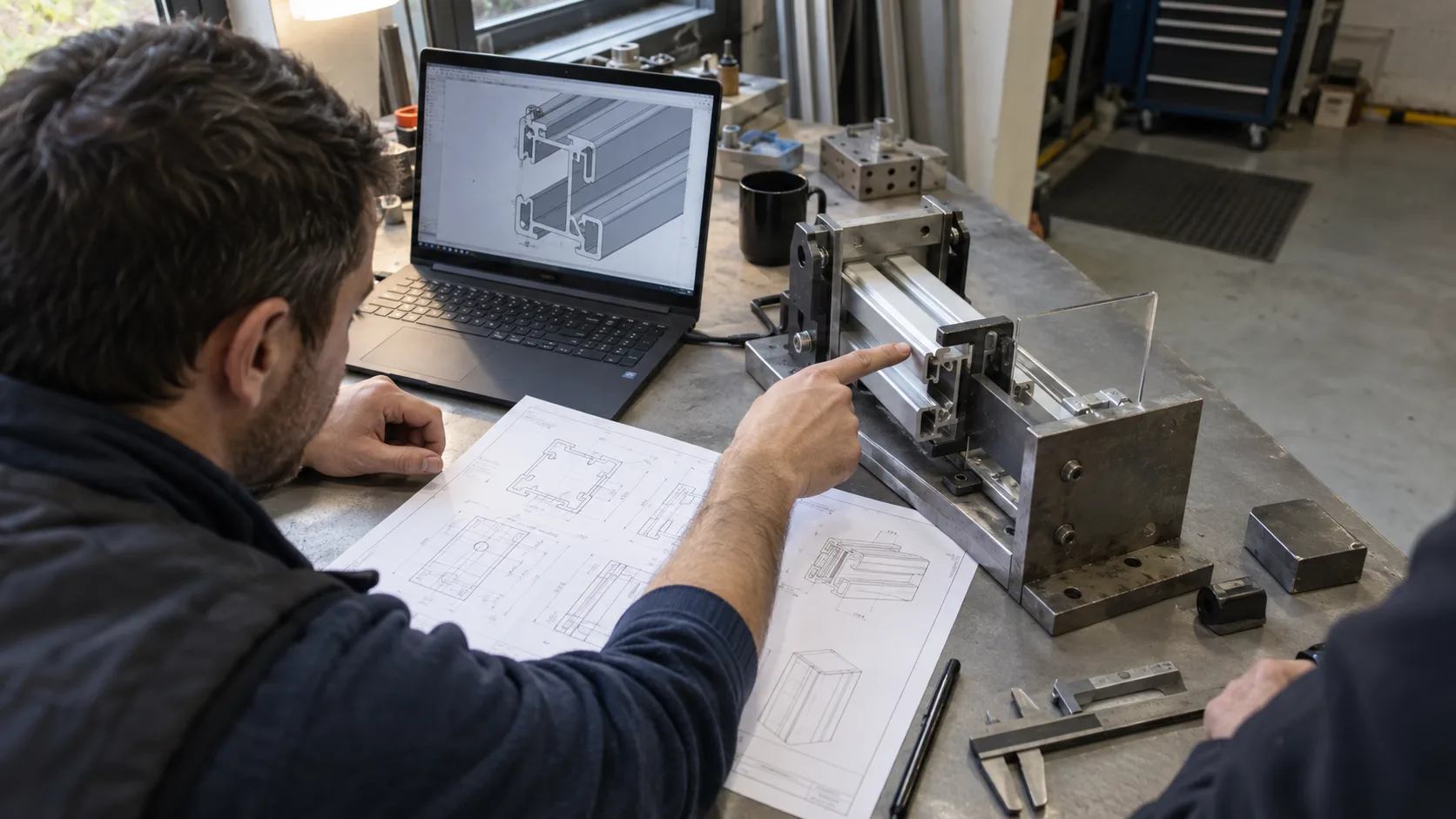
Drawing to die
The review connects section geometry, application interfaces, material selection, finishing, fabrication and expected demand before the tooling route is agreed.
Review the cross-section, functional interfaces and critical geometry before the tooling route is defined.
Align the proposed alloy, temper, finish and secondary operations with the application and profile route.
Agree the drawing revision, inspection points and sample-approval expectations before repeat production.
Development gates
The exact route changes with the profile, but each decision should remain tied to an agreed drawing and acceptance basis.
Share a PDF, CAD file, image or controlled reference.
Review function, geometry, alloy, temper, finish and downstream operations.
Define the tooling route after manufacturability review.
Develop tooling against the approved section and review inputs.
Produce a trial route where new tooling or profile validation is required.
Inspect the sample against the agreed drawing and acceptance plan.
Record the approved revision before repeat production.
Run the agreed extrusion, finish and secondary-operation route.
Protect, identify and release profiles against the order requirement.
Start with what you know
A drawing or reference and a clear application are enough to begin the conversation. Alloy, temper and tolerance fields can remain unknown while the requirement is reviewed.
Start drawing reviewDie development FAQs
Final feasibility, timing and commercial terms are confirmed only after the specific profile and order route are reviewed.
Send a cross-section drawing, CAD file, sketch, image or physical reference together with the application, critical dimensions, quantity expectation, finish and any downstream operations. Unknown alloy, temper and tolerance fields can be left open for review.
Yes. An early concept can be reviewed to identify missing inputs and discuss manufacturability. Tooling development proceeds only against an agreed profile definition and review inputs.
Not necessarily. The first step is to compare the requirement with available profile families and tooling. A new die route is considered when an existing section does not meet the agreed functional and geometric need.
Where trial and validation are required, the sample is checked against the agreed drawing and acceptance plan. The approved revision is then recorded before repeat production.
Drawing-led RFQ
Share the cross-section and application for an initial manufacturability review. Unknown alloy, temper and tolerance fields can be left open.
Tooling and DFM
A custom extrusion die is developed around the approved profile requirement, production route, trial observations, dimensional checks, and agreed acceptance criteria.
Extrusion feasibility and DFM review consider walls, hollows, tongues, symmetry, transitions, screw ports, interfaces, visible faces, fabrication allowances, and inspection access. Findings are specific to the submitted geometry.
Custom extrusion die development can progress through drawing review, tooling scope, die trial, sample measurement, correction where required, and customer approval. Prototype timing and acceptance are confirmed for the project.